

CSS Blog
The Stories We Tell: Land Acknowledgements & Indigenous Sovereignty


We wear the threads of so many stories in our lives, often without examining their weave more closely.
The practice of land acknowledgements is a well-intended attempt by non-indigenous organizations to address a broken collective relationship with history, the erasure of genocide and colonization, and alienation from the land upon which human life depends. And, the most well-intended narrative interventions can still be bent to the will and need of domination and power-over.
Do land acknowledgements, as practiced, tell the story that our movements need? Do they open up new futures for indigenous sovereignty and movement solidarity? Or do they reinforce stories about justice and reparations being far out of reach? CSS looks to indigenous communities for leadership on the questions raised in this conversation, while also assuming an active and accountable role in our own storytelling.
Let’s start with a written land acknowledgement that feels like a fair representation of how many are phrased. This one is from an academic institution — not linked here because the point of this exercise is not the critique of specific wordsmithing or a single institution. Let’s look at this brief statement as an example of the wider practice:
“We pause to acknowledge that this University sits on the land of the Ohlone and the Muwekma Ohlone people, who trace their ancestry through the Missions. We remember their connection to this region and give thanks for the opportunity to live, work, learn and pray on their traditional homeland. Let us take a moment of silence to pay respect to their Elders and to all Ohlone people past and present.”
There are various Elements of Story on display here. Unpacking these elements helps one analyze how the story works, as currently written. Use the arrow buttons to scroll across:
Elements of Story: Land Acknowledgements

The backbone of narrative, what defines the drama, point of view, and makes the story interesting
• Reminder of who’s homeland this is; that story is currently hidden
• Remembering vs. Forgetting
• Guilt vs. Permission
• “give thanks for the opportunity” claims resources and power as part of that opportunity
• Acknowledging vs. Taking Responsibility for
• Acknowledgement and Respect vs. Accountability and Responsibility
• History vs. Current Life/Living People

The subjects, protagonists, and narrators of stories
• Ohlone and the Muwekma Ohlone people(past and present)
• “We/Us” (invisibilized and obfuscated)
• University
• Land
• (paying)Respect

Words to capture imagination with metaphor, anecdote, and descriptions that speak to the senses and make the story tangible
• Reads like a eulogy
• Prayer
• Meditative
• Moment of Silence-y
• Dimensions of Time
• Tracing their Ancestry (implies a peaceful passage of people vs. enslavement)

The ways that a story provides hints to its outcome
• Nothing is changing, it’s already done
• Acknowledgement is a momentary, no mention of the future – just past and present
• Ghosts of the past and the people living in the present are living in harmony

What one must believe, in order to believe the story is true
• If we recall the past, we don’t have to talk about the future
• Saying the acknowledgement absolves us from our privilege or gains from colonization, missions, settlers, etc. (i.e. Thanksgiving myth – opportunity was given to us)
• This was a natural occurrence – like manifest destiny
• A moment of silence is paying respect, and that is “enough”
• Giving thanks and being thankful are important
• Learning about history is a part of paying respect
• Individual growth leads to personal transformation (focus of individual as unit of change, becoming an individual witness)
• Because we’re here, we deserve to stay here (no question about giving up/back the land)
Drama Triangle
Next, Drama Triangle is a simple tool to help explore the structure of conflict in a story. Naming the hero, victim, and villain in one story, can help clarify similarities and differences with another. And when the current story is not to our liking, moving and re-casting characters in the drama triangle can help us experiment with new storytelling strategies.
Any story is fair game for drama triangle, and there’s no better place to start than stories we tell about ourselves.
Land acknowledgements happen in a particular context of shared culture and politics across many movement organizations, nonprofits, and other spaces. Often one of the unexamined assumptions in the stories we tell ourselves is that we, the storyteller, are the good ones, the heroes. Getting comfortable with the complexity of accountability, not always being heroes, considering assessments of our stories that demand corrective action — are all important outcomes of this sort of narrative reflection.
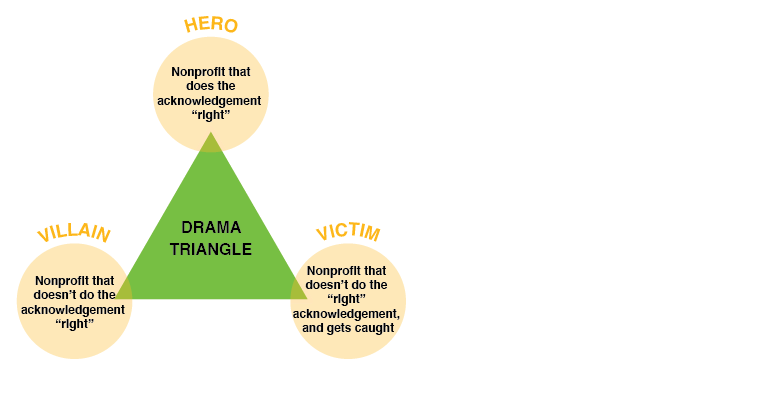
When organizations check a box “we did a land acknowledgement!!” without pairing it with action, we may feel good, while fear of being insufficiently “woke” may prevent others from taking any action. Non-indigenous led organizations cast ourselves as villains anytime we stop at analysis and fail to root practices like land acknowledgements within relationships, both with indigenous spaces and with the land itself.
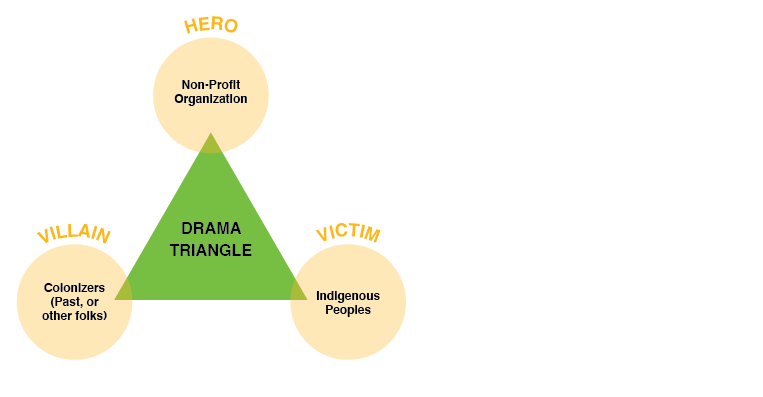
We imagine this is the drama triangle for the story many folks have in their heads. It’s an easy one, and easy to find yourself in the hero role.
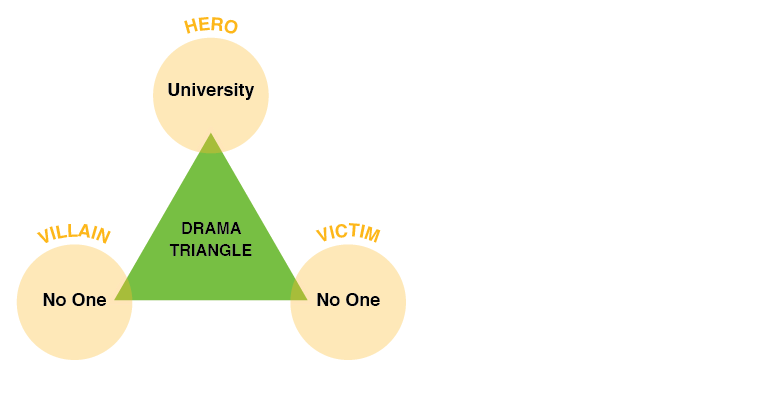
Land acknowledgement statements like this one can fail to cast the villain and the victim, prompting us to wonder what kind of accountability is possible with a story that doesn’t name the stakes.
Taking Action
As we work to bring our organizational culture in line with our values, this exploration of land acknowledgement narratives helps clarify a few things for us:
-
Leaving our villains in history encourages North Americans to mourn the loss of diversity while ignoring the present power dynamics. You should be wary of telling stories that you aren’t in — this one is enticing because it moves non-Indigenous folks out of the story, and thus away from accountability.
-
We call them land acknowledgements, but our relationship with the land itself is often made invisible. We can avoid falling into passive progressive messaging by naming the land as a character in our stories, acknowledging active land struggles during acknowledgements, and donating to a local Land Tax.
-
Land acknowledgements are a tiny piece of the larger fight for indigenous sovereignty and turning us to right-relation with the natural world. Support People’s Orientation for a Regenerative Economy. Following the leadership of movement partners like Indigenous Environmental Network, we know there is no climate justice without indigenous sovereignty.
.summary-header-text {
font-weight: bold;
font-size: 20px;
}
.summary-title-link {
font-size: 20px;
}
.summary-metadata-item, .summary-metadata-item–date {
display: none !important;
}
.summary-carousel-pager-next, .summary-carousel-pager-prev {
background-color: #FFB81C !important;
color: black !important;
font-weight: bold:
}